 Skip to content
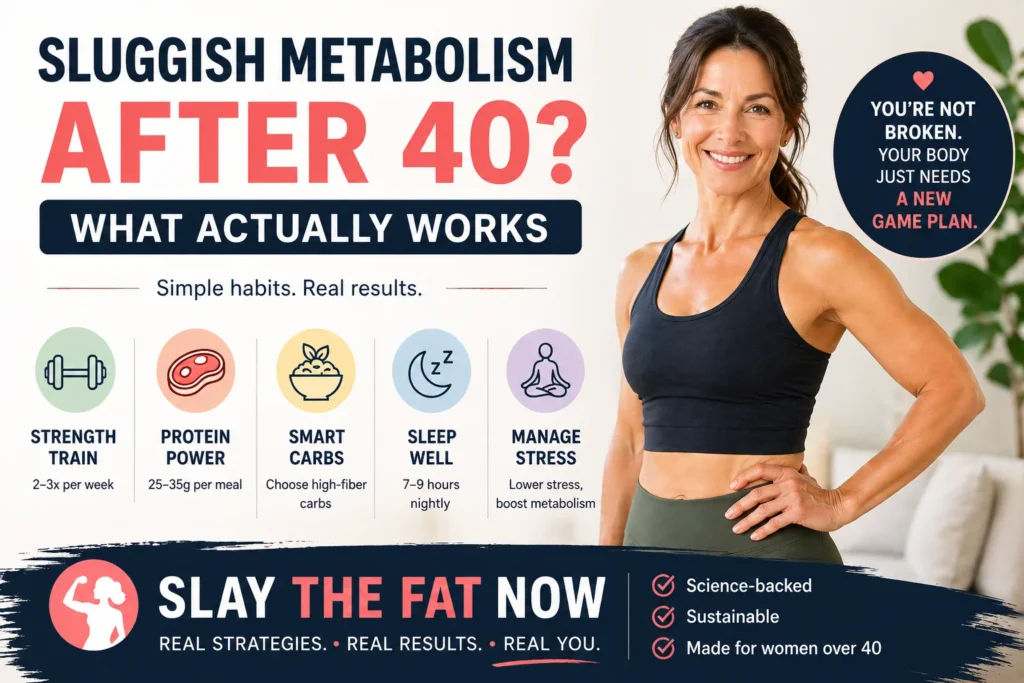
Sluggish Metabolism After 40?
Here’s What Actually Works
A sluggish metabolism after 40 is caused by muscle loss, hormonal shifts, and lifestyle changes. To boost it: do strength training 2–3x per week, eat 25–35g protein per meal, choose high-fiber carbs, sleep 7–9 hours nightly, and manage stress actively. These strategies directly counter age-related metabolic decline.
“I’m eating less than I ever have — and still gaining weight. What is wrong with me?”
If that sentence hit close to home, you are not broken. You are not lazy. And you are definitely not imagining it. After 40, your body plays by a completely different set of rules — rules that most diet advice completely ignores.
You try the same calorie-cutting approach that worked in your 30s. You walk more. You skip dessert. And the scale barely budges. Meanwhile, your younger coworker loses five pounds just by “cutting out soda.” It feels deeply unfair. That’s because, biologically speaking, it kind of is.
But here’s what nobody tells you: you have far more control over your metabolism than you think. The changes are real, but so are the solutions. And they don’t require you to starve yourself, spend hours at the gym, or buy into another miracle supplement.
This guide is everything I wish someone had handed me before years of trial and error — built from real client transformations, peer-reviewed research, and the kind of honest truth that actually helps people over 40 lose fat for good.
What Is Metabolic Slowdown After 40 — And Why Does It Happen?
Your Basal Metabolic Rate (BMR) is the number of calories your body burns just to keep you alive — breathing, pumping blood, maintaining temperature. This is the foundation of your metabolism, and it naturally changes as you age.
Three primary forces drive a sluggish metabolism after 40:
Muscle Loss
Starting around age 30, most adults lose 3–8% of muscle mass per decade without resistance training. Muscle burns more calories at rest than fat — so less muscle = slower metabolism.
Hormonal Shifts
Estrogen decline in women (perimenopause/menopause) and gradually falling testosterone in men both accelerate fat storage and slow calorie burn.
Lifestyle Creep
More stress, less sleep, more desk time. Chronically elevated cortisol promotes belly fat storage and wrecks insulin sensitivity over time.
The key insight? Every single one of these factors is partially — often significantly — within your control. That is the premise of everything we’ll cover here.

Why Fixing Your Metabolism After 40 Matters More Than Ever
This isn’t just about fitting into old jeans. A faster, more efficient metabolism after 40 delivers compounding benefits across your entire health profile:
- Sustained fat loss without extreme calorie restriction
- Improved blood sugar control and reduced risk of type 2 diabetes
- Higher energy levels throughout the day — no more 3pm crashes
- Better hormonal balance, mood stability, and mental clarity
- Stronger bones and joints (a bonus of muscle-building work)
- Reduced inflammation — a key driver of aging and chronic disease
- Greater confidence and a stronger sense of physical identity
According to the CDC National Health Statistics, obesity rates in adults aged 40–59 in the United States hover around 44.8%. The metabolic changes of midlife are a major driver — but they’re not inevitable.

The Science: What the Data Actually Says
3–8%Muscle mass lost per decade after 30 (without resistance training)
200–400Extra calories burned daily by adding 10 lbs of muscle mass
30%Higher thermic effect of protein vs. carbs and fats
55%Greater belly fat accumulation linked to chronic sleep deprivation
A landmark study published in the New England Journal of Medicine found that total daily energy expenditure remains relatively stable from age 20 to 60 — meaning the dramatic metabolic slowdown many people experience in their 40s and 50s is not entirely age-driven. It is largely behavior-driven. Sedentary lifestyle, muscle loss, and poor sleep quality are doing the heavy lifting (pun intended).
Research from the National Institutes of Health also confirms that resistance training can increase resting metabolic rate by 7–8% over 16 weeks in previously sedentary adults over 40. That’s significant. You are not fighting biology — you are working with it.

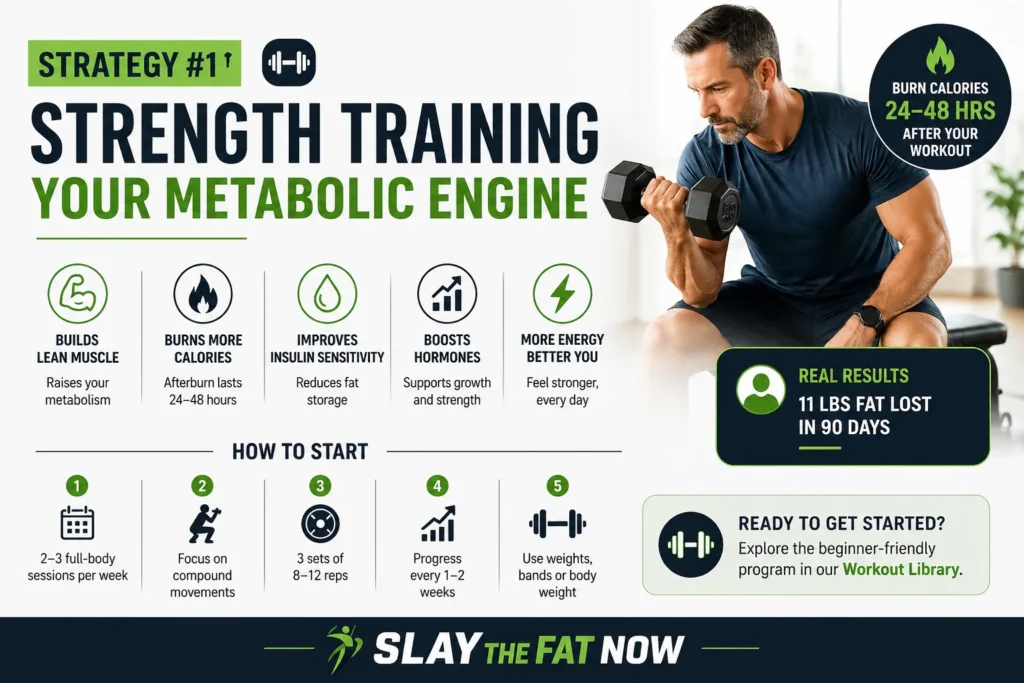
Strategy #1 — Strength Training: Your Metabolic Engine
If there is one single non-negotiable for boosting a sluggish metabolism after 40, this is it. Not walking. Not cycling. Not yoga (though those have their place). Resistance training.
Here’s why it works so powerfully:
- Builds and preserves metabolically active muscle tissue, raising your BMR permanently over time
- Triggers EPOC (Excess Post-exercise Oxygen Consumption) — the “afterburn” that keeps burning calories 24–48 hours after your session
- Improves insulin sensitivity, reducing fat storage from the carbs you do eat
- Boosts growth hormone and testosterone naturally — both of which decline with age
🏋️ Real Client Story
Michael, 47, replaced his daily 45-minute treadmill walk with three 30-minute full-body lifting sessions. He felt intimidated at first — hadn’t touched weights since college. Within 90 days, his shirts fit differently across the chest and shoulders, his energy improved dramatically, and he dropped 11 pounds of fat without changing a single meal. His secret wasn’t suffering more. It was training smarter.
How to Start — Practical Steps
- Aim for 2–3 full-body sessions per week, with at least one rest day between
- Focus on compound movements: squats, deadlifts, rows, presses, lunges
- Start with 3 sets of 8–12 reps per exercise at a challenging but manageable weight
- Progress gradually — increase weight or reps every 1–2 weeks
- Body weight, resistance bands, dumbbells, or machines all work equally well
For a beginner-friendly strength program designed specifically for people over 40, visit the SlayTheFatNow Workout Library.
Strategy #2 — Protein Power: Your Metabolism’s Best Friend
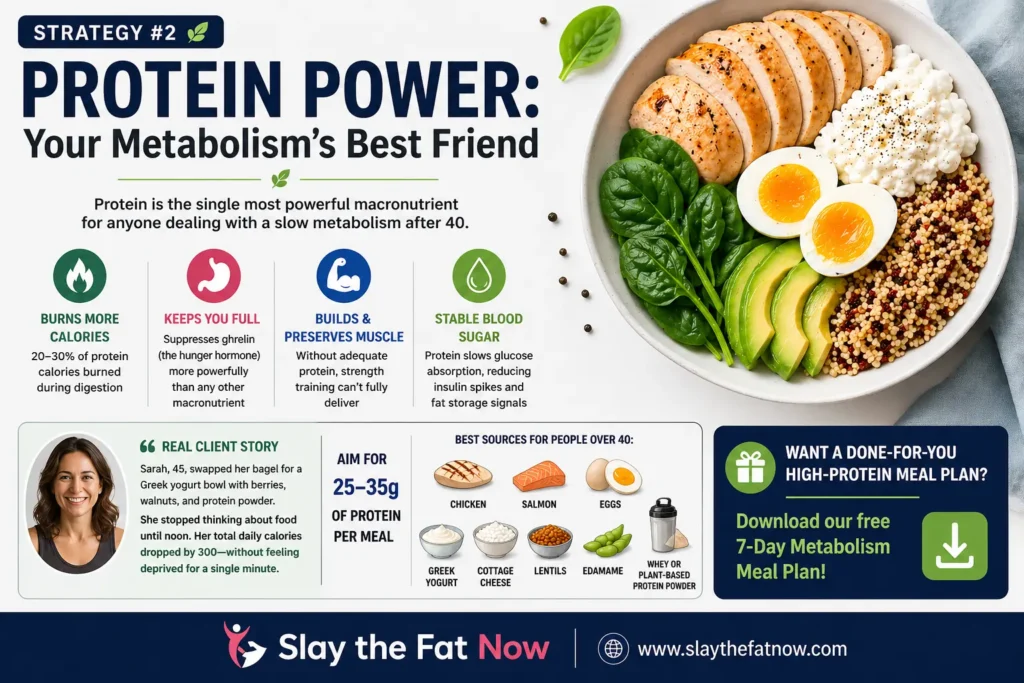
Protein is the single most powerful macronutrient for anyone dealing with a slow metabolism after 40. Most people over 40 are chronically undereating it. Here’s the metabolic case for protein:
- Thermic Effect: Your body burns 20–30% of protein calories just during digestion — vs. 5–10% for carbs and 0–3% for fat
- Satiety: Protein suppresses ghrelin (the hunger hormone) more powerfully than any other macronutrient
- Muscle preservation: Without adequate protein, strength training can’t fully deliver — your body needs raw material to rebuild
- Blood sugar stability: Protein slows glucose absorption, reducing insulin spikes and fat storage signals
🥗 Real Client Story
Sarah, 45, used to start her day with a quick bagel and coffee. By the time she walked into work, she was already craving a snack. We swapped her breakfast for a Greek yogurt bowl with berries, walnuts, and a scoop of protein powder. She stopped thinking about food until noon. Her total daily calories actually dropped by 300 — without feeling deprived for a single minute.
Aim for 25–35 grams of protein per meal. Best sources for people over 40: chicken breast, salmon, eggs, Greek yogurt, cottage cheese, lentils, edamame, and whey or plant-based protein powder as needed.
Want a done-for-you high-protein meal plan built around your calorie targets? Download our free 7-Day Metabolism Meal Plan.
Strategy #3 — Smart Carbohydrates: Quality Over Quantity
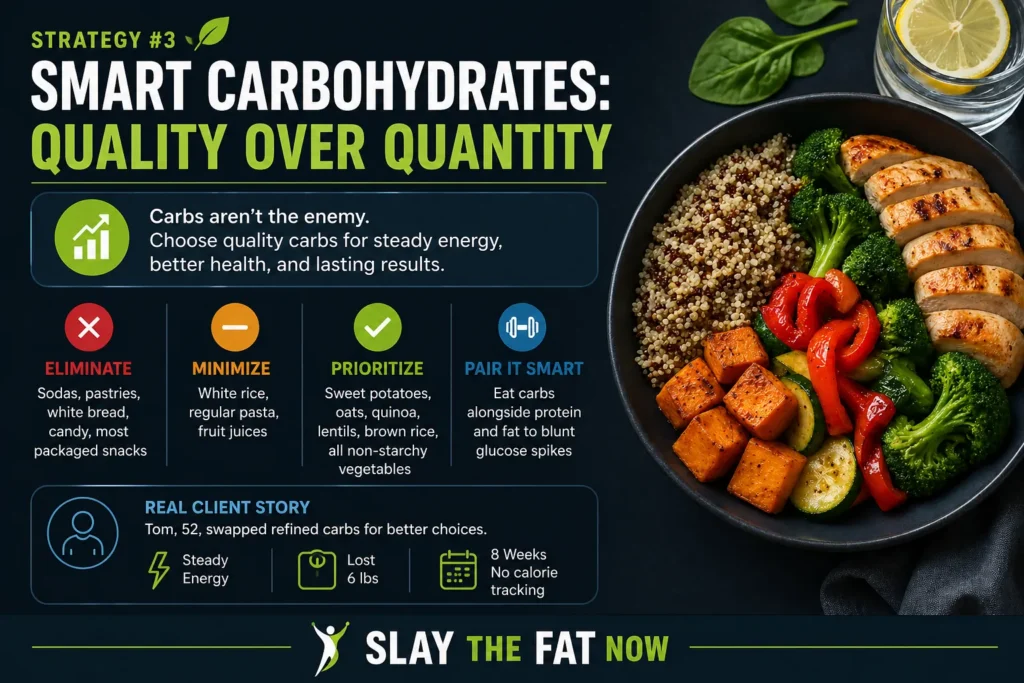
Carbs are not the enemy. Processed, refined, blood-sugar-spiking carbs are — especially after 40, when insulin sensitivity naturally declines.
The goal isn’t to eliminate carbs. It’s to upgrade them. Fiber-rich, complex carbohydrates provide steady energy, feed your gut microbiome (increasingly linked to metabolic health), and keep you fuller longer.
🍽️ Real Client Story
Tom, 52, was a lifelong pasta-and-white-bread guy. His energy would peak and crash multiple times a day. When he replaced his usual carbs with brown rice, sweet potato, and a much bigger serving of non-starchy vegetables, his afternoon energy flatlined — in a good way. Steady, consistent energy. And within 8 weeks, he’d lost 6 pounds without tracking a single calorie.
- Eliminate: sodas, pastries, white bread, candy, most packaged snacks
- Minimize: white rice, regular pasta, fruit juices
- Prioritize: sweet potatoes, oats, quinoa, lentils, brown rice, all non-starchy vegetables
- Eat carbs alongside protein and fat to blunt glucose spikes
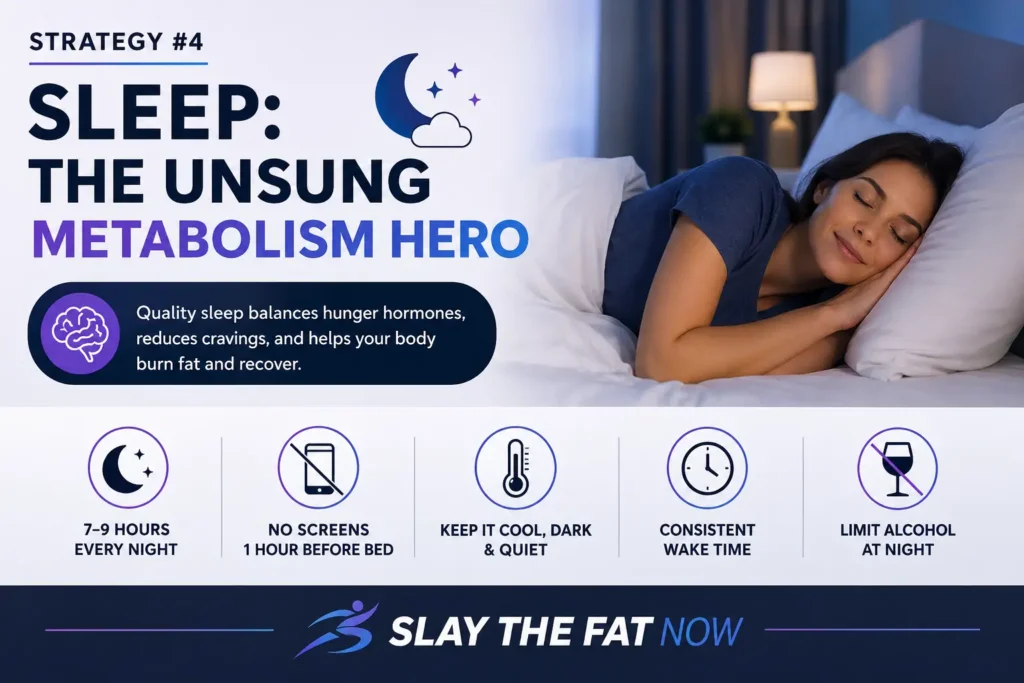
Strategy #4 — Sleep: The Unsung Metabolism Hero
This one surprises most people. Sleep isn’t passive. It is when your body repairs muscle, regulates fat-storage hormones, and resets your appetite signaling. Chronic sleep deprivation — even just one week of six-hour nights — measurably increases cortisol, raises ghrelin, and drops leptin.
Translation: you wake up hungrier, less satisfied after eating, and more inclined to reach for high-sugar comfort food. Your willpower isn’t weak. Your hormones are dysregulated.
😴 Real Client Story
Lisa, 50, was proud of her ability to function on 5–6 hours of sleep. She called it “efficiency.” When she finally committed to 7.5 hours per night for just three weeks, her food cravings dropped so significantly she thought something was wrong. Her energy for workouts tripled. Her mood was noticeably better. She lost 4 pounds without changing a single meal.
- Target 7–9 hours of quality sleep per night — consistency matters as much as duration
- No screens at least 60 minutes before bed (blue light suppresses melatonin)
- Keep your bedroom cool (65–68°F / 18–20°C), dark, and quiet
- Establish a consistent wake time — even on weekends
- Limit alcohol: it fragments sleep architecture even when it helps you fall asleep
Strategy #5 — Stress Management: Taming Cortisol
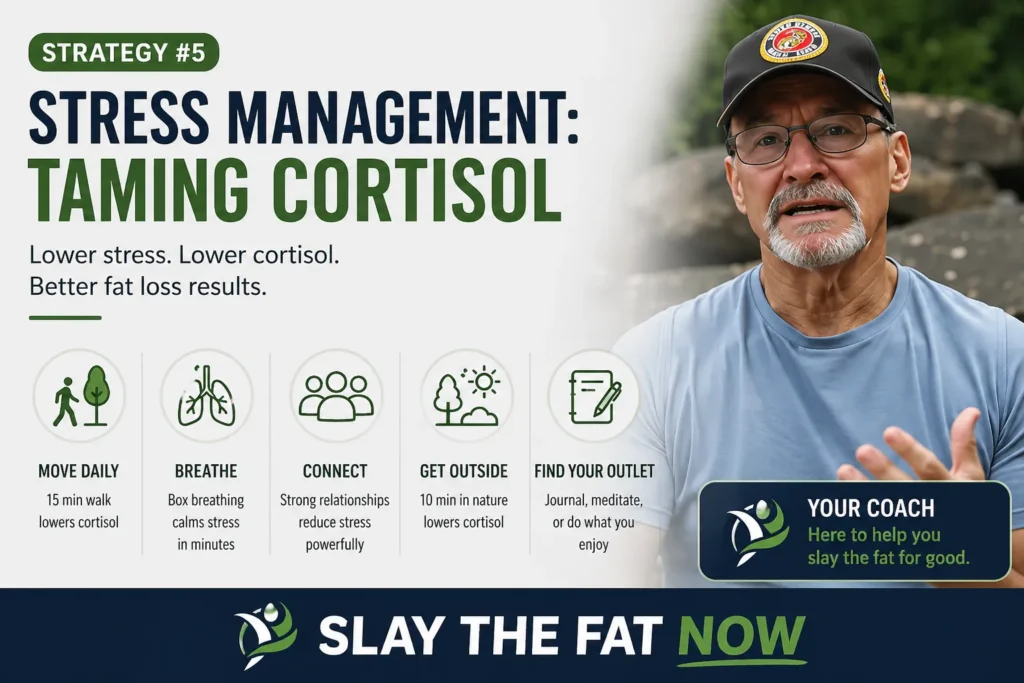
Chronic stress is a metabolic saboteur hiding in plain sight. Cortisol — your primary stress hormone — directly promotes fat storage in the abdominal region and drives cravings for high-fat, high-sugar foods. After 40, when stress often peaks (career, family, financial pressure), this becomes a critical lever to manage.
🧘 Real Client Story
David, 49, used to destress with a nightly bowl of chips and a couple of beers while scrolling his phone. He replaced that ritual with a 20-minute walk outside, no headphones, just nature and movement. Three weeks in, he reported the lowest anxiety levels of his adult life — and his evening snacking virtually disappeared without any effort.
- Daily movement — even a 15-minute walk — significantly reduces cortisol
- Box breathing (inhale 4 counts, hold 4, exhale 4, hold 4) activates the parasympathetic nervous system in minutes
- Social connection is one of the most potent stress-reducers available
- Nature exposure lowers cortisol measurably — even 10 minutes outdoors helps
- Journaling, meditation, and hobbies all qualify — find what works for you
Benjamin Sley — Weight Loss Coach
Certified coach specializing in fat loss for adults 40+ across the United States
What I’ve Learned Coaching Hundreds of People Over 40
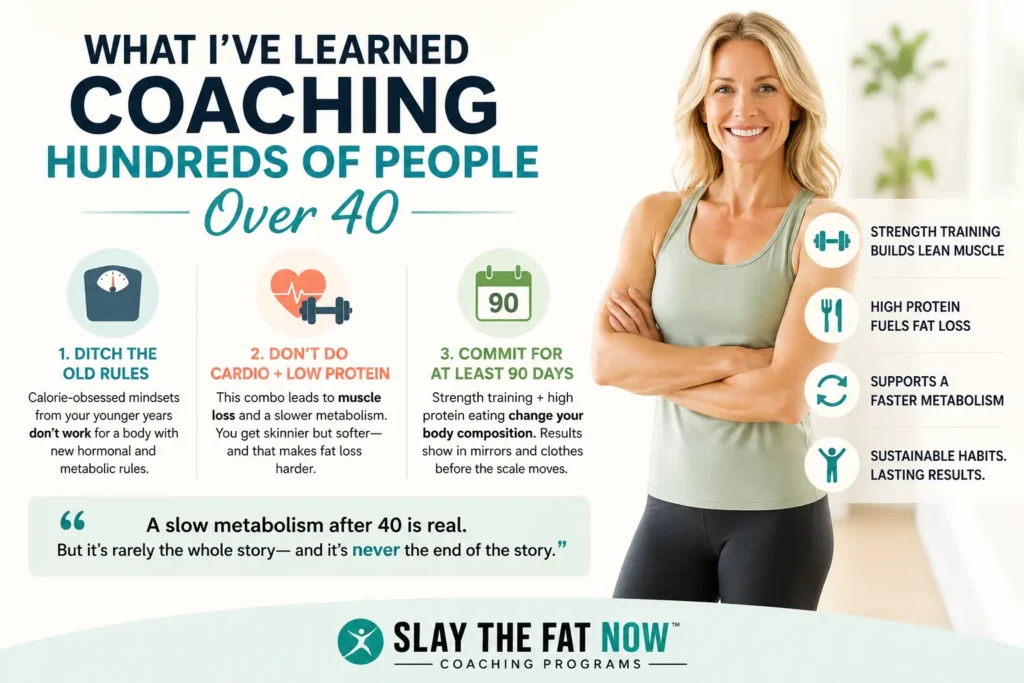
In my years working as a weight loss coach, the most common mistake I see from new clients over 40 is coming in with a calorie-obsessed mindset from their younger years — eat less, move more — applied to a body that now operates on completely different hormonal and metabolic rules.
The second most common mistake? Going all in on cardio while eating minimal protein. This is a recipe for muscle loss, which directly worsens the metabolism problem you’re trying to solve. You end up skinnier but softer, with a slower metabolism than when you started.
The clients who transform most dramatically share one trait: they commit to strength training and high-protein eating for at least 90 days before judging results. The metabolic shift is real — but it takes time to manifest on the scale. Body composition changes often show up in mirrors and clothing before numbers move.
Learn more about how our coaching approach works at SlayTheFatNow Coaching Programs.
“A slow metabolism after 40 is real. But it’s rarely the whole story — and it’s never the end of the story.”
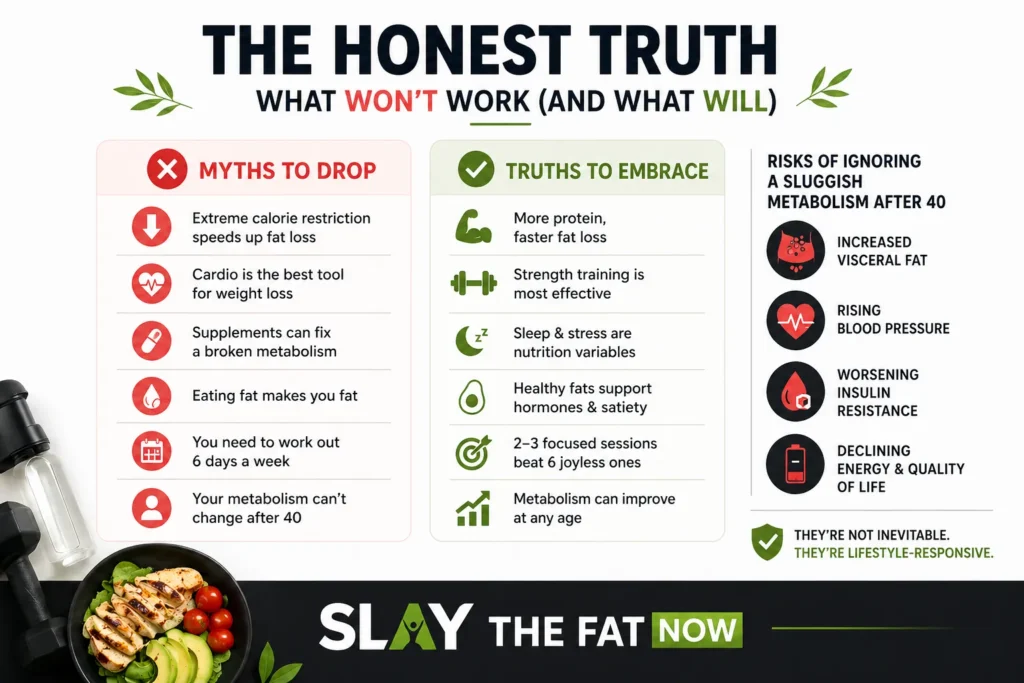
The Honest Truth: What Won’t Work (And What Will)
❌ Myths to Drop
- Extreme calorie restriction speeds up fat loss
- Cardio is the best tool for weight loss
- Supplements can fix a broken metabolism
- Eating fat makes you fat
- You need to work out 6 days a week
- Your metabolism can’t change after 40
✅ Truths to Embrace
- Eating more protein (not less) accelerates fat loss
- Strength training is the most metabolically effective exercise
- Sleep and stress are nutrition variables, not lifestyle extras
- Healthy fats support hormones and satiety
- 2–3 focused sessions outperform 6 joyless ones
- Metabolic rate can measurably improve at any age
The risks of ignoring a sluggish metabolism after 40 are real: increasing visceral fat (the type that surrounds organs), rising blood pressure, worsening insulin resistance, and declining energy quality of life. But these aren’t inevitable. They’re lifestyle-responsive.
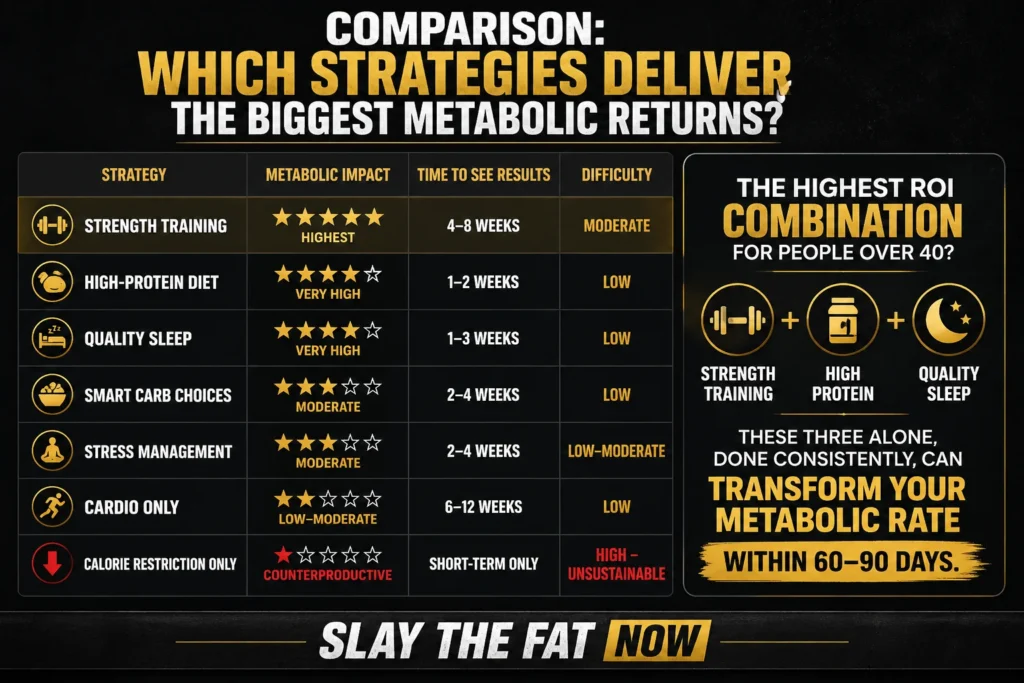
Comparison: Which Strategies Deliver the Biggest Metabolic Returns?
| Strategy | Metabolic Impact | Time to See Results | Difficulty |
|---|---|---|---|
| Strength Training | ★★★★★ Highest | 4–8 weeks | Moderate |
| High-Protein Diet | ★★★★☆ Very High | 1–2 weeks | Low |
| Quality Sleep | ★★★★☆ Very High | 1–3 weeks | Low |
| Smart Carb Choices | ★★★☆☆ Moderate | 2–4 weeks | Low |
| Stress Management | ★★★☆☆ Moderate | 2–4 weeks | Low–Moderate |
| Cardio Only | ★★☆☆☆ Low–Moderate | 6–12 weeks | Low |
| Calorie Restriction Only | ★☆☆☆☆ Counterproductive | Short-term only | High — unsustainable |
The highest ROI combination for people over 40? Strength training + high protein + quality sleep. These three alone, done consistently, can transform your metabolic rate within 60–90 days.
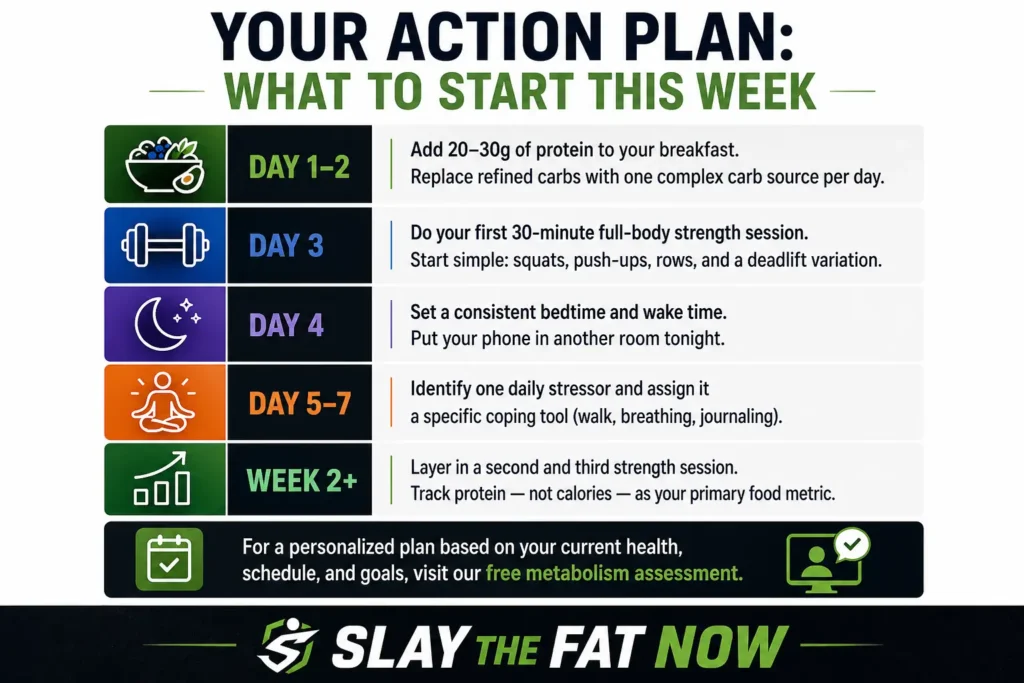
Your Action Plan: What to Start This Week
- Day 1–2: Add 20–30g of protein to your breakfast. Replace refined carbs with one complex carb source per day.
- Day 3: Do your first 30-minute full-body strength session. Start simple: squats, push-ups, rows, and a deadlift variation.
- Day 4: Set a consistent bedtime and wake time. Put your phone in another room tonight.
- Day 5–7: Identify one daily stressor and assign it a specific coping tool (walk, breathing, journaling).
- Week 2+: Layer in a second and third strength session. Track protein — not calories — as your primary food metric.
For a personalized plan based on your current health, schedule, and goals, visit our free metabolism assessment at SlayTheFatNow.
Frequently Asked Questions
Real questions from people over 40 trying to lose weight and boost their metabolism.
Can you really boost your metabolism after 40?Q
Yes — research from the NIH confirms that resistance training can increase resting metabolic rate by 7–8% in sedentary adults over 40 within 16 weeks. The key drivers of metabolic slowdown (muscle loss, poor sleep, stress) are all modifiable with the right behaviors.
Why is losing weight so much harder after 40?Q
Three primary reasons: age-related muscle loss reduces your resting calorie burn, hormonal changes (estrogen/testosterone) shift fat storage patterns, and lifestyle factors like chronic stress and less sleep elevate cortisol, which promotes belly fat. All three can be addressed with targeted strategies.
How much protein do you need after 40 to lose weight?Q
Most nutrition research supports 0.7–1.0 grams of protein per pound of body weight for adults over 40 who are trying to lose fat and preserve muscle. Practically, aim for 25–35g per meal across 3–4 meals per day.
Is strength training safe for people over 40?Q
Yes — and it’s one of the most recommended interventions by sports medicine doctors and gerontologists for adults over 40. Start with lighter weights and proper form. If you have existing joint issues, consult your physician first, but resistance training in some form is appropriate for virtually all healthy adults.
Does sleep really affect weight loss after 40?Q
Profoundly. Even one week of sleeping 5–6 hours per night significantly elevates ghrelin (hunger hormone) and drops leptin (satiety hormone), leading to consuming an average of 300–500 extra calories daily — without realizing it. Prioritizing 7–9 hours is a metabolic intervention, not a luxury.
What are the best foods to boost metabolism after 40?Q
Lean proteins (chicken, fish, eggs, Greek yogurt), fiber-rich vegetables, complex carbohydrates (sweet potato, oats, quinoa), healthy fats (salmon, avocado, nuts), green tea, and coffee in moderation. These support muscle, reduce inflammation, and keep blood sugar stable.
How long does it take to see metabolic improvements?Q
Most people notice improved energy, reduced cravings, and better sleep within 2–3 weeks of combined protein increase, strength training, and sleep consistency. Visible body composition changes typically appear at 6–12 weeks. Measurable metabolic rate increases are documented at 8–16 weeks.
Can stress cause weight gain in people over 40?Q
Absolutely. Chronic stress elevates cortisol, which directly promotes visceral fat accumulation (belly fat), increases cravings for high-calorie foods, disrupts sleep, and causes insulin resistance. Stress management is a legitimate metabolic intervention, not just “wellness advice.”
Is intermittent fasting effective for metabolism after 40?Q
The evidence is mixed. For some people over 40, time-restricted eating helps reduce overall calorie intake and improves insulin sensitivity. For others — especially women in perimenopause — extended fasting can increase cortisol and worsen hormonal disruption. Start with protein timing and sleep before experimenting with fasting.
Do metabolism-boosting supplements work after 40?Q
Most supplements marketed as “metabolism boosters” produce minimal effects — often under 50 extra calories per day — and none can compensate for poor sleep, low protein, or sedentary behavior. The foundational strategies in this article produce far greater, more lasting results.
What is sarcopenia and how does it affect weight loss?Q
Sarcopenia is the age-related loss of muscle mass and strength, beginning around age 30 and accelerating after 50 without intervention. Since muscle tissue burns more calories at rest than fat tissue, losing muscle directly reduces your BMR — making fat loss progressively harder. Strength training is the primary countermeasure.
How does menopause affect metabolism?Q
Declining estrogen during perimenopause and menopause shifts fat storage from the hips and thighs to the abdomen, reduces insulin sensitivity, and can disrupt sleep — all of which slow metabolism. Resistance training and high-protein eating are particularly powerful interventions during this transition.
Should I cut carbs completely to boost my metabolism after 40?Q
No. Complete carb elimination is unnecessary and often backfires — leading to muscle glycogen depletion, low energy for workouts, and hormonal disruption. The goal is to replace refined carbohydrates with fiber-rich, complex sources. Quality matters far more than quantity.
What is EPOC and why does it matter for people over 40?Q
EPOC (Excess Post-exercise Oxygen Consumption) is the elevated calorie burn that continues after a workout — especially after strength training and high-intensity interval work. For people over 40, EPOC from a single 30-minute strength session can elevate metabolism for up to 24–48 hours post-workout.
Can walking boost metabolism after 40?Q
Walking is genuinely valuable — it reduces cortisol, improves insulin sensitivity, and supports cardiovascular health. However, it does not build the muscle mass needed to raise BMR significantly. For maximum metabolic impact, combine daily walking with 2–3 weekly strength training sessions.
Ready to Reignite Your Metabolism?
You’ve read the research. You know the strategy. Now it’s time to put it into motion — with expert guidance built specifically for people over 40. Book Your Free Coaching Call Take the Free Assessment
No pressure. No upsells. Just an honest conversation about your goals — with a coach who’s helped hundreds of people over 40 transform their metabolism.
